
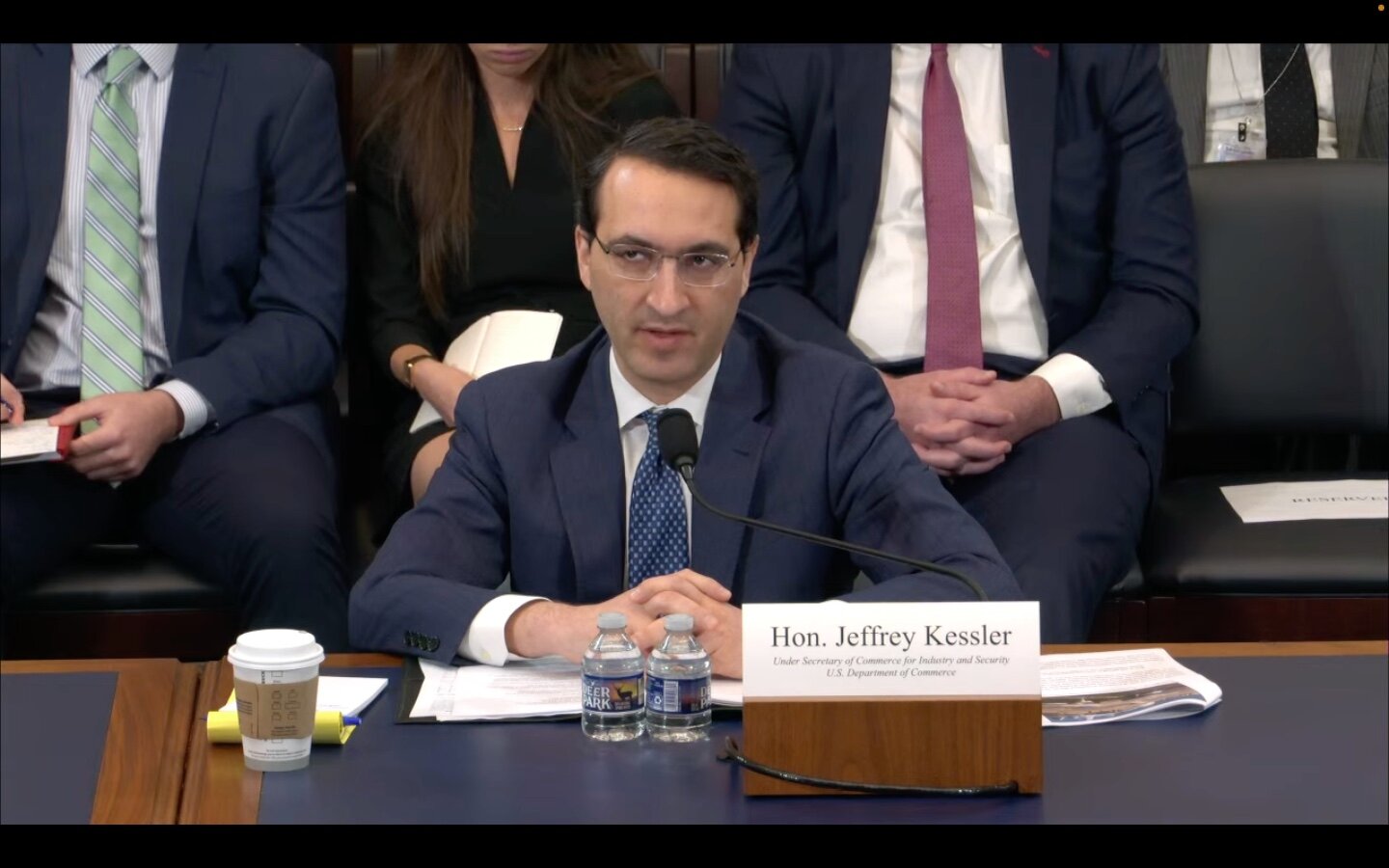
The agency’s public docket shows fewer administrative actions under Under Secretary Jeffrey Kessler, even as several enormous semiconductor cases pushed assessed penalties higher.
The Commerce Department agency responsible for keeping sensitive American technology out of the hands of China, Russia and other adversaries is seeking an unprecedented expansion of its budget and enforcement workforce. But publicly reported administrative enforcement activity has fallen by roughly half since Jeffrey Kessler took control of the Bureau of Industry and Security.
An analysis of BIS’s public enforcement registers found that the agency recorded 70 export-control and antiboycott actions from Kessler’s confirmation in March 2025 through August 3, 2026. That equals an annualized rate of approximately 51 actions, compared with 99 a year during the preceding 24 months—a decline of about 49%.
The figures measure public administrative docket activity, including settlements, charging letters, temporary denial orders and conviction-based export-denial orders. They do not capture investigations opened internally, warning letters, unannounced seizures or every criminal case in which BIS agents participated.
Still, the decline presents a striking contrast with the administration’s plans for the agency.
The Commerce Department’s fiscal 2027 request would increase the BIS budget to $450 million from $235 million, a rise of nearly 92%. The proposal includes an additional $151.9 million for export enforcement and operational support, adding 313 positions and 235 full-time-equivalent employees. The administration has proposed adding 290 export-enforcement agents and 23 support specialists.
That request follows an earlier proposal by Kessler for what he called the largest investment in BIS history. In June 2025, he asked Congress for $303 million to hire almost 200 special agents, increase the number of overseas export-control officers from 12 to 30 and add engineers and technical experts.
“These enforcement efforts are not only critical to protect national security, but they also can pay for themselves in penalty revenue,” Kessler told lawmakers.
Kessler was confirmed by the Senate on March 13, 2025, by a 54-45 vote.
The lower action count does not mean BIS has gone easy on major corporate offenders.
Since February 2025, the agency has assessed approximately $396.6 million in nominal civil penalties across 12 identified corporate export-control matters. Almost 88% of that total came from two cases involving the Chinese semiconductor sector.
Applied Materials and its Korean subsidiary agreed in February 2026 to pay approximately $252 million for exporting semiconductor-manufacturing equipment to China without the required licenses. BIS described the penalty, twice the value of the transactions, as the second largest in its history.
Cadence Design Systems received a $95.3 million BIS penalty in July 2025 for unauthorized exports of electronic-design-automation products and semiconductor technology to Chinese organizations associated with military supercomputing and nuclear-weapons development.
Other actions included a $36.2 million penalty against Robert Bosch GmbH over foreign-produced sensors and software supplied to Huawei affiliates; a $4.25 million settlement with Alpha and Omega Semiconductor; and penalties involving Exyte Management, Solventum, Coastal PVA Technology and Teledyne FLIR.
Those cases illustrate an enforcement strategy increasingly focused on semiconductor supply chains. They also show BIS applying American export rules to foreign subsidiaries, foreign-produced products, software access, overseas distributors and transfers occurring entirely within China.
The penalty totals require qualification. Coastal PVA’s $1.7 million assessment was fully suspended and may ultimately be waived. Portions of the Cadence and Bosch assessments were coordinated with or credited against Justice Department payments. Nominal penalties therefore do not equal the amount of money collected by BIS.
The preceding period was similarly distorted by one enormous case: BIS’s $300 million April 2023 settlement with Seagate Technology. Large-dollar outliers make average penalties a poor measure of ordinary enforcement activity.
BIS’s public enforcement register combines fundamentally different actions.
Some entries represent settlements resolving newly charged corporate violations. Others are temporary denial orders intended to stop an imminent export violation. Still others renew earlier orders against the same Russian or Iranian airlines and procurement networks.
A substantial share consists of conviction-based denial orders issued after a defendant has already been prosecuted. BIS frequently publishes these orders in large batches. Counting every entry as a separate new enforcement case can therefore overstate the number of distinct investigations completed during a period.
Even with those limitations, the same counting method produces a clear decline: the public registers contain 198 export-control and antiboycott entries between February 2023 and January 2025, compared with 71 between February 2025 and August 3, 2026. Removing the single action recorded before Kessler’s confirmation leaves 70 during his tenure.
BIS can point to broader indicators that are not reflected in the administrative docket. In his June 2025 testimony, Kessler said that, during the administration’s opening months, BIS and its law-enforcement partners had secured 22 criminal convictions, made 32 arrests, obtained 38 indictments, detained 231 shipments valued at more than $185.5 million and seized 79 shipments worth more than $40 million.
Those figures measure different outcomes and may involve cases initiated before Kessler took office. They nevertheless demonstrate why public administrative orders alone cannot provide a complete assessment of the agency’s performance.
The push for additional resources follows years of concern that BIS lacks the personnel needed to administer an expanding system of export controls.
The Government Accountability Office found that BIS funding grew by $97 million, roughly doubling between fiscal years 2013 and 2024. Funded positions increased from 403 to 585. But GAO also found that the bureau had not conducted comprehensive workforce planning since 2016.
Commerce initially agreed that BIS should develop a long-term workforce plan. The department later told GAO that it did not intend to provide further responses, and as of May 2026 had reported no progress implementing the recommendation.
Congress must now decide whether to approve another dramatic expansion. The administration argues that hundreds of new agents and overseas officers are necessary to police global technology flows and confront increasingly sophisticated diversion networks.
The public results to date tell a more complicated story: fewer reported administrative actions, but a small number of exceptionally large penalties aimed at the technologies and Chinese companies the administration considers most consequential.
Whether the proposed expansion produces a broader increase in cases—or simply more intensive pursuit of a handful of strategic targets—will be the central test of Kessler’s enforcement program.
Note: At presstime, our queries to the BIS Office of Congressional and Public Affairs were not answered.


Comments
No comments on this item Please log in to comment by clicking here