
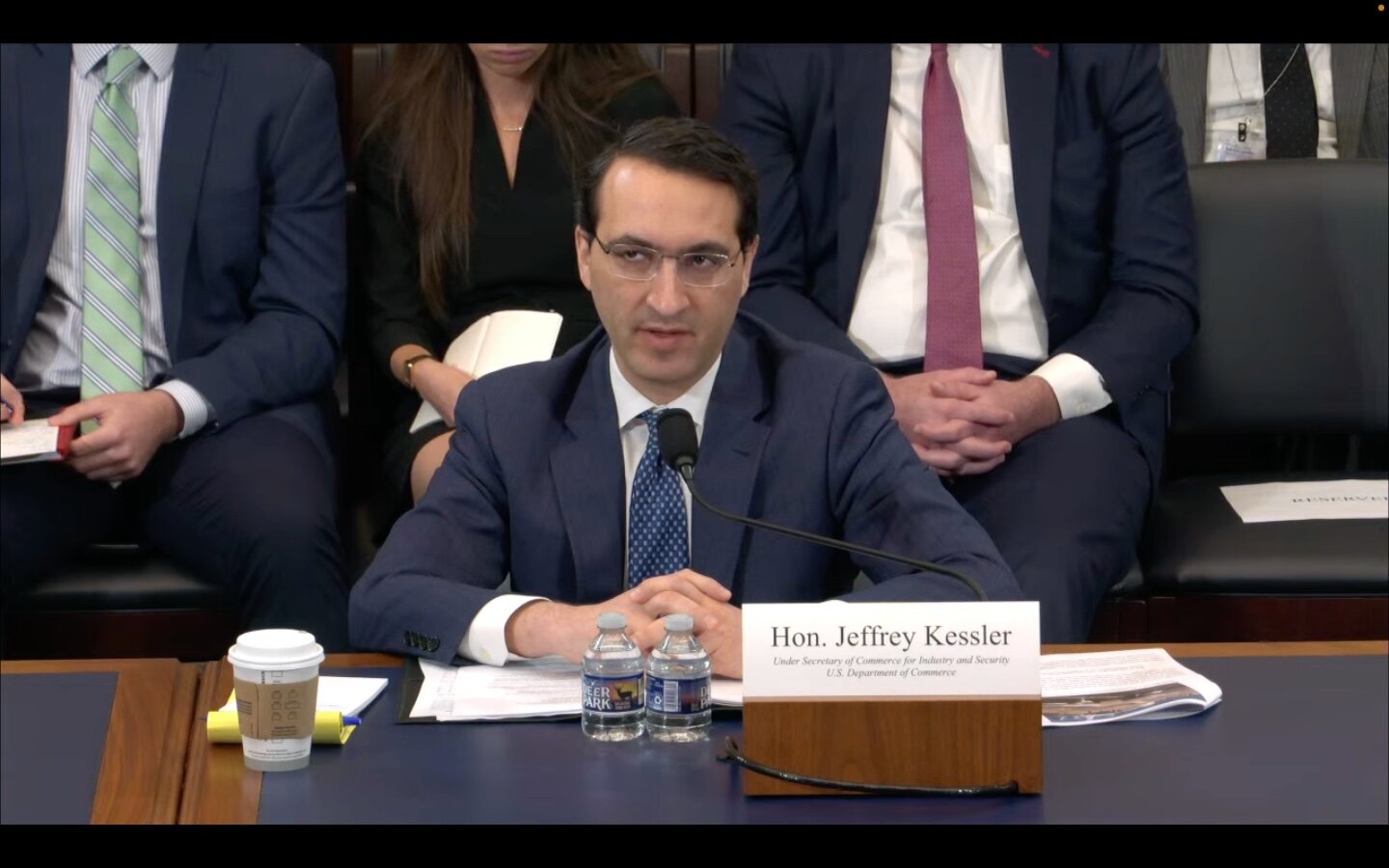
Nearly three months after Under Secretary of Commerce for Industry and Security Jeffrey Kessler assured Congress that his bureau was “driving forward” U.S. export control policy, internal and external frustrations are mounting over what industry, lawmakers, and former officials describe as a near-paralysis in licensing and rulemaking.
Testifying before the House Foreign Affairs Subcommittee on South and Central Asia on June 12, Kessler faced sharp bipartisan criticism over missing budget justification documents, licensing delays, and BIS’s failure to finalize rules. [13910]
He denied using export controls as bargaining chips in trade talks, stating, “When we impose controls, it’s based on national security and foreign policy interests, not trade leverage.” He acknowledged reviewing, and in some cases slowing, license approvals to avoid “rubber-stamping” applications.
Kessler defended rescinding the Biden administration’s “Byzantine” AI Diffusion Rule, arguing it was “not ready for prime time” and diplomatically alienating.
So far, BIS has alternated between tightening semiconductor controls and cutting unprecedented deals to loosen them — leaving exporters, lawmakers, and allies unsure who is calling the shots. The year’s most striking example came in August - Nvidia and Advanced Micro Devices agreed to pay 15% of China sales revenues from certain AI chips in exchange for export licenses.
The arrangement covers Nvidia’s H20 and AMD’s MI308, chips tailored for China after Biden-era rules blocked sales of more advanced models. According to Financial Times reporting, licenses began issuing two days after Nvidia CEO Jensen Huang met President Trump, following months of stalled approvals.
BIS had announced a ban on the H20 in April, only for the White House to reverse course in June — part of a broader reported freeze on new China controls to avoid disrupting trade talks.
Export control veterans say no U.S. agency has ever conditioned a license on a revenue share. The Export Control Reform Act (50 U.S.C. § 4815(c)) bars fees tied to license processing, and the Constitution’s Export Clause prohibits taxes on exports. Whether the 15% remit is a “fee,” a “tax,” or a lawful license condition remains untested.
Critics warn it sets a dangerous precedent. “If exports present a real national security risk, a 15% U.S. government cut doesn’t solve it,” former NSC China director Liza Tobin told the FT. Others caution that tying agency budgets to license revenue could erode security judgments.
The licensing reversal has united an unusual coalition of conservative and Democratic voices:
Twenty conservative national-security figures — including Stewart Baker, Matt Pottinger, David Feith, Brad Carson, Lloyd Thrall, and Oren Cass — urged Commerce Secretary Howard Lutnick to deny the H20 license, calling it “a potent accelerator of China’s frontier AI”.
Senior Senate Democrats — Mark Warner, Chuck Schumer, Jack Reed, Chris Coons, Elizabeth Warren — warned of “a serious national security risk” and criticized using controls as bargaining chips in trade talks.
House Democratic leaders Gregory Meeks and Raja Krishnamoorthi said lifting the ban only three months after imposing it contradicts sworn testimony and undermines credibility. Republican Rep. John Moolenaar added his own warning against selling “vital AI assets to Chinese entities”.
Multiple reports indicate the H20 license was part of a broader trade calculus. Administration officials have linked it to a Chinese concession on rare earth magnets, critical to U.S. defense and clean tech manufacturing. The sequence — ban in April, reversal in June, revenue-share licenses in August — coincided with White House efforts to pave the way for a Trump–Xi summit.
Enforcement Elsewhere: Southeast Asia and the Gulf
While China-related restrictions have eased, BIS is preparing a new licensing regime for AI chip exports to Malaysia and Thailand, aimed at closing diversion routes. A draft rule, still under review, would require licenses for sales to those markets but include exemptions for allied firms and packaging operations.
Separately, a UAE AI chip deal backed by President Trump is bogged down in interagency disputes over whether Abu Dhabi’s G42 group should get direct access, given alleged Chinese ties. Licensing for U.S. companies to supply chips and build UAE data centers remains unresolved.
BIS’s 2025 record reflects a mix of assertive diversion control and politically driven exceptions. On one hand, it has deployed covert trackers to catch illegal resales and coordinated prosecutions, including in Singapore. On the other, sudden reversals — sometimes within days of CEO–White House meetings — have created the perception that export control policy is as much a trade negotiation tool as a security instrument.
Commerce Secretary Howard Lutnick has promoted the administration’s trade agenda, but BIS has failed to issue long-promised rules, lost staff through buyouts and resignations, and discouraged contact with industry. One official described the licensing backlog as the longest in over three decades.
Key regulatory changes—including expanded restrictions on subsidiaries of blacklisted firms—remain unpublished, and vacancies for critical enforcement positions, such as China-based export control officers, remain unfilled.
Industry groups told Reuters the delays are eroding U.S. market share. “We’re seeing whole sectors where there is no movement or indication if or when licenses will be issued,” said Sean Stein, president of the US-China Business Council, noting Chinese firms are securing alternative suppliers.
As one former senior official put it privately: “Industry can’t plan when the signals keep changing. It’s not clear whether BIS, the White House, or the trade negotiators are setting the rules.”


Comments
No comments on this item Please log in to comment by clicking here